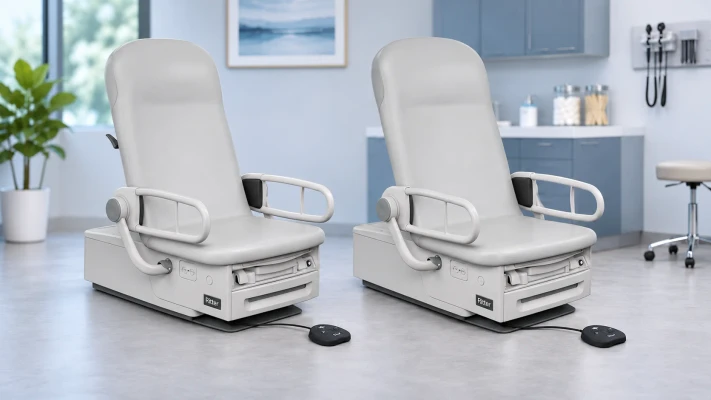
Meet the Midmark Ritter 228 and 229 Barrier-Free Exam Chairs
New from Midmark
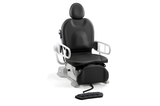
~4 min readThe Midmark Ritter 228 and 229 Barrier-Free® Examination Chairs replace the long-running 224 and 225. Both lower to a 17″ seat height, meeting the 2024 US Access Board standard, and rise to 37″ for exams. The 228 has a manual backrest and the 229 has a powered one.
Key takeaways
- The 228 replaces the 224, and the 229 replaces the 225.
- Both lower to 17″, 1.5″ lower than the chairs they replace, and meet the 2024 US Access Board standard.
- 500 lb patient capacity, a 28″ wide transfer surface and a 37″ working height.
- Five models: 228-001, 228-002, 228-003, 229-002 and 229-003.
- They take the same Midmark accessories as the 224 and 225, including the ADA Patient Support Rails.
What changed from the 224 and 225
The 224 and 225 have been Midmark's core barrier-free exam chairs for years. The 228 and 229 keep what worked, including the capacity, the working height, the backrest travel and the upholstery colors. The main change is the low height.
| Ritter 224 / 225 | Ritter 228 / 229 | |
|---|---|---|
| Lowest seat height | 18.5″ | 17″ |
| Accessibility standard | 2017 standard (17–19″) | 2024 US Access Board standard (17″ or lower) |
| Highest seat height | 37″ | 37″ |
| Patient capacity | 500 lbs | 500 lbs |
| Durability | Lifecycle tested beyond real-world use, for less downtime |
Why 17″ matters. The DOJ and HHS rules currently accept a 17–19″ transfer height, but both agencies have signaled they plan to adopt the Access Board's 2024 standard of 17″ or lower. A chair that already reaches 17″ won't need replacing if they do. Our ADA exam table compliance guide covers the rules in detail.
228 or 229: manual or powered backrest
The two chairs share the same base, top and options. The difference is the backrest.
- Ritter 228: a gas spring backrest. Squeeze the release handle on either side to recline it from upright to flat. Height is powered and runs from the foot control.
- Ritter 229: a powered backrest. Height and backrest both run from the foot control, and an optional hand control (9A681001) is available.
Choose the 229 if staff reposition patients many times a day or you want hands-free positioning. Choose the 228 if a manual back is fine and you want the lower price.
Features on every model
- 17″ to 37″ powered seat height
- 28″ wide transfer surface that works with portable patient lifts
- Extendable 16″ footrest that takes the chair from 60″ to 76″ long
- Rail accessory receivers and a tool-free spline for accessories
- Works with automated vital signs devices like the Midmark Digital Vital Signs Device
- Contoured headrest (seamless and pillowed, hides the paper roll holder) or Flat headrest (thinner, squared-off top)
- Standard premium vinyl or UltraFree urethane upholstery, which looks and feels like leather
- 1-year Midmark warranty
Compare the five models
| Model | Backrest | Adds |
|---|---|---|
| 228-001 | Manual | The base chair |
| 228-002 | Manual | Hideaway stirrups, 5¼° pelvic tilt, heated drawer (92–112°F), outlets on both sides, Active Sensing Technology® |
| 228-003 | Manual | Everything on the 228-002, plus Clean Assist Rollers |
| 229-002 | Powered | Hideaway stirrups, 5¼° pelvic tilt, heated drawer (92–112°F), outlets on both sides, Active Sensing Technology® |
| 229-003 | Powered | Everything on the 229-002, plus Clean Assist Rollers |
Active Sensing Technology stops the chair if it meets an obstruction while it moves. Clean Assist Rollers let staff roll the chair away from the wall to clean behind and under it.
Accessories
The 228 and 229 take the same Midmark accessories as the 224 and 225:
- ADA Patient Support Rails and Patient Support Rails+. These can be added when you configure the chair.
- Articulating Knee Crutches and Assist Arms
- Ritter 253 LED Exam Light (choose the 253-012 exam chair kit)
- Stainless Steel Debris Tray (fits every model except the 228-001)
Launch pricing. To celebrate the launch, every 228 and 229 configuration is on sale, and curbside delivery is free for members. Membership is free.
Frequently asked questions
What is the difference between the Midmark 228 and 229?
The backrest. The 228 has a gas spring backrest that you recline by hand. The 229 has a powered backrest that runs from the foot control. Height is powered on both.
Do the 228 and 229 replace the 224 and 225?
Yes. The 228 is the next generation of the 224, and the 229 is the next generation of the 225. The main change is the lower 17″ seat height (the 224 and 225 lower to 18.5″).
Do the 228 and 229 meet ADA requirements?
Yes. Both lower to 17″, which meets the 2024 US Access Board standard for accessible exam chairs as well as the 17–19″ range the DOJ and HHS rules currently accept. Pair either chair with the ADA Patient Support Rails for transfer support.
What is the weight capacity of the Midmark 228 and 229?
500 lbs (227 kg). If you need 650 lbs, heated upholstery or a built-in scale, look at the Midmark 626.
Sources
- Midmark Ritter 228/229 Barrier-Free Examination Chair User Guide and Brochure
- U.S. Access Board — Standards for Accessible Medical Diagnostic Equipment (36 CFR Part 1195)
Recent Posts
-

Year-End Medical Equipment Buying & Section 179 Guide (2026)
Medical equipment that’s delivered and ready to use by December 31 can lower your 2026 taxes. Here’s …16th Nov 2026 -
Meet the Midmark Ritter 228 and 229 Barrier-Free Exam Chairs
New from Midmark ~4 min read The Midmark Ritter 228 and 229 Barrier-Free® Examination Chairs repla …16th Nov 2026 -
Medical Office Equipment Checklist: Room-by-Room Guide
Opening a practice or adding exam rooms? This room-by-room checklist covers the equipment a medical …16th Nov 2026