ADA Exam Table & Wheelchair Scale Requirements: 2026 Compliance Guide
Compliance Guide
~7 min readNew federal rules require most healthcare facilities to have accessible diagnostic equipment in place by 2026. Here's exactly what "accessible" means for exam tables and weight scales — and how to meet both requirements without overbuying.
Two separate requirements — counted & enforced independently
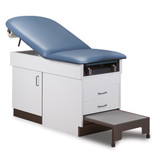
Accessible exam table / chair
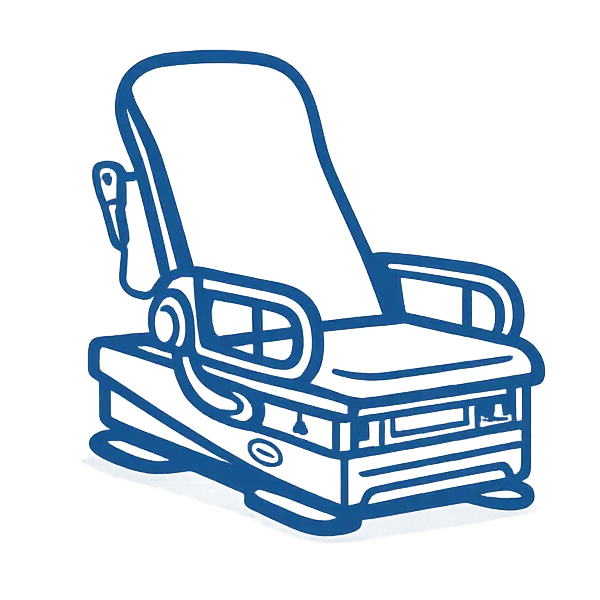
Lowers to a transfer height a wheelchair user can transfer onto.
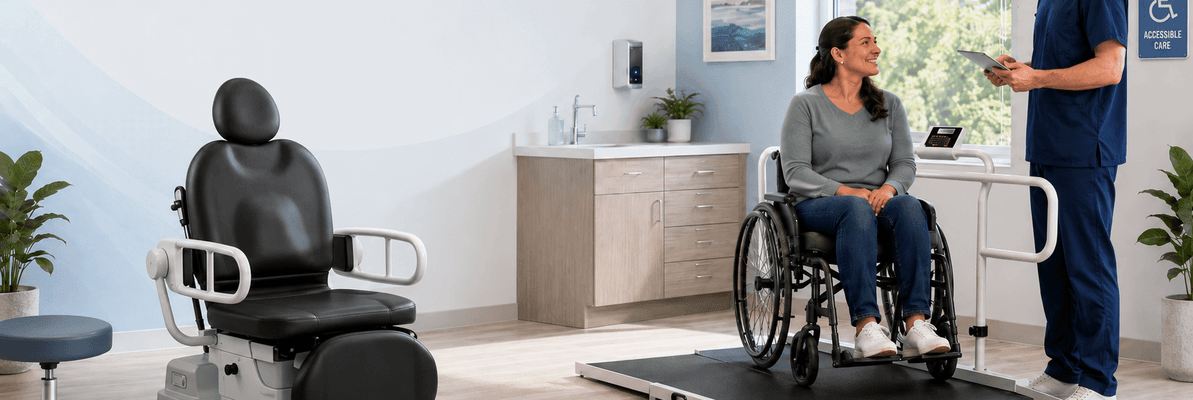
Accessible weight scale
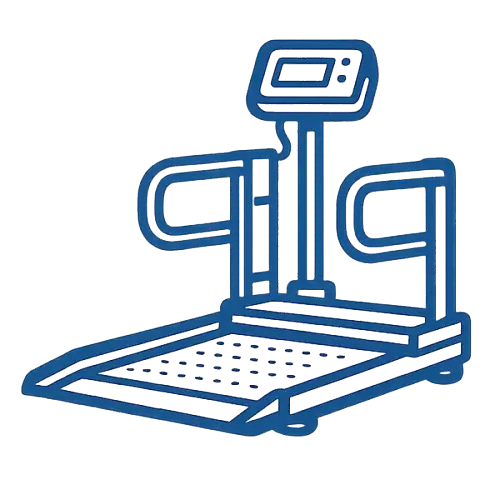
A roll-on platform that weighs a patient who can't leave the chair.
Key takeaways
- Covered facilities need both an accessible exam table and an accessible wheelchair scale — two separate requirements.
- Deadlines: July 8, 2026 (HHS-funded providers) and August 9, 2026 (state/local government).
- An exam table's built-in scale does not meet the wheelchair-scale requirement.
- A compliant wheelchair scale needs a roll-on platform, an accessible ramped entry (max 1:12, or 1:8 for low-rise runs), and edge protection — and ideally third-party certification.
- You don't have to replace everything: the threshold is 10% of each equipment type (20% for mobility-focused practices).
Why these rules exist
For years, patients who use wheelchairs have faced a basic barrier to care: exam tables fixed at roughly 32 inches that are difficult or impossible to transfer onto, and weight scales that require standing. In 2024, two federal actions changed that from best practice into an enforceable requirement. The U.S. Access Board finalized updated technical standards for medical diagnostic equipment (MDE), and the Department of Justice (Title II) and Department of Health and Human Services (Section 504) adopted those standards as enforceable rules for the facilities they cover.
If your practice participates in Medicare, Medicaid, or CHIP, or is operated by a state or local government, the rules apply to you.
The single most important thing to understand
Exam tables and weight scales are two separate obligations. They are counted separately and enforced separately. A facility that buys a beautiful, fully compliant exam table has satisfied exactly half of the requirement. This trips up a lot of buyers, so it's worth stating plainly: you need at least one accessible table and at least one accessible scale.
What the deadlines actually are
Oct 8, 2024
Jul 8, 2026
Aug 9, 2026
Newly acquired MDE must comply
HHS-funded providers: ≥1 table & ≥1 scale
State/local gov: same minimum
You are not required to replace every table and scale. As you acquire new equipment, it must be accessible until at least 10% of each equipment type meets the standards (a minimum of one unit) — or 20% for practices that specialize in treating mobility-related conditions.
What makes an exam table compliant
An accessible exam table (or a reclining exam chair used as a table) has to let a patient transfer independently from a mobility device. The core technical criteria:
| Criterion | Requirement |
|---|---|
| Transfer height | Transfer surface reaches 17–19″ from the floor M301.2.1 / M302.2.1 |
| Transfer surface size | Table, end approach: 28″ W × 17″ L min Table, side approach: 28″ W × 28″ L min Chair, seated: 21″ W × 17″ D min |
| Unobstructed transfer | One long side and one short side clear; support rail removable or repositionable |
| Transfer supports | Must meet requirements for location, length, height, cross-section, gripping surface, clearance, surface hazards, and non-rotation in fittings M305.2 |
| Lift compatibility | Base provides clearance for a portable patient floor lift |
The 17″ vs. 17–19″ question. The Access Board's 2024 final rule sets a single 17″ low transfer height, but the enforceable DOJ and HHS rules currently allow the 17–19″ range. Choosing a table that reaches 17″ or lower is the future-proof move.
What makes a wheelchair scale compliant
An accessible weight scale under the M303 standard is fundamentally different from a stand-on scale: it's a roll-on platform that weighs a patient without requiring them to stand or transfer. To be compliant it needs:
- A platform large enough for a wheelchair to roll fully on (roughly 32–36″ minimum width)
- An accessible entry onto the platform — if ramped, generally no steeper than 1:12; a 1:8 slope is only permitted for low-rise ramp runs with a maximum rise of 2.5″
- Raised edge protection so the wheelchair can't roll off
- A slip-resistant surface and adequate (often bariatric) weight capacity
Many low-profile ADA wheelchair scales use a 1:8 ramp specifically because their platform sits low enough for the rise to fall within that 2.5″ exception.
Watch the "ADA-friendly" trap. Not every scale marketed as ADA-friendly actually meets the standard. The reliable signal is independent third-party certification (for example, Corada Platinum certification). Certified compliance also reduces exposure to regulatory challenges based on unverified claims.
How the Midmark 626 fits — and where it doesn't
A common question we get: "Our Midmark 626 has a built-in scale — are we done?" Not quite, and the distinction matters.
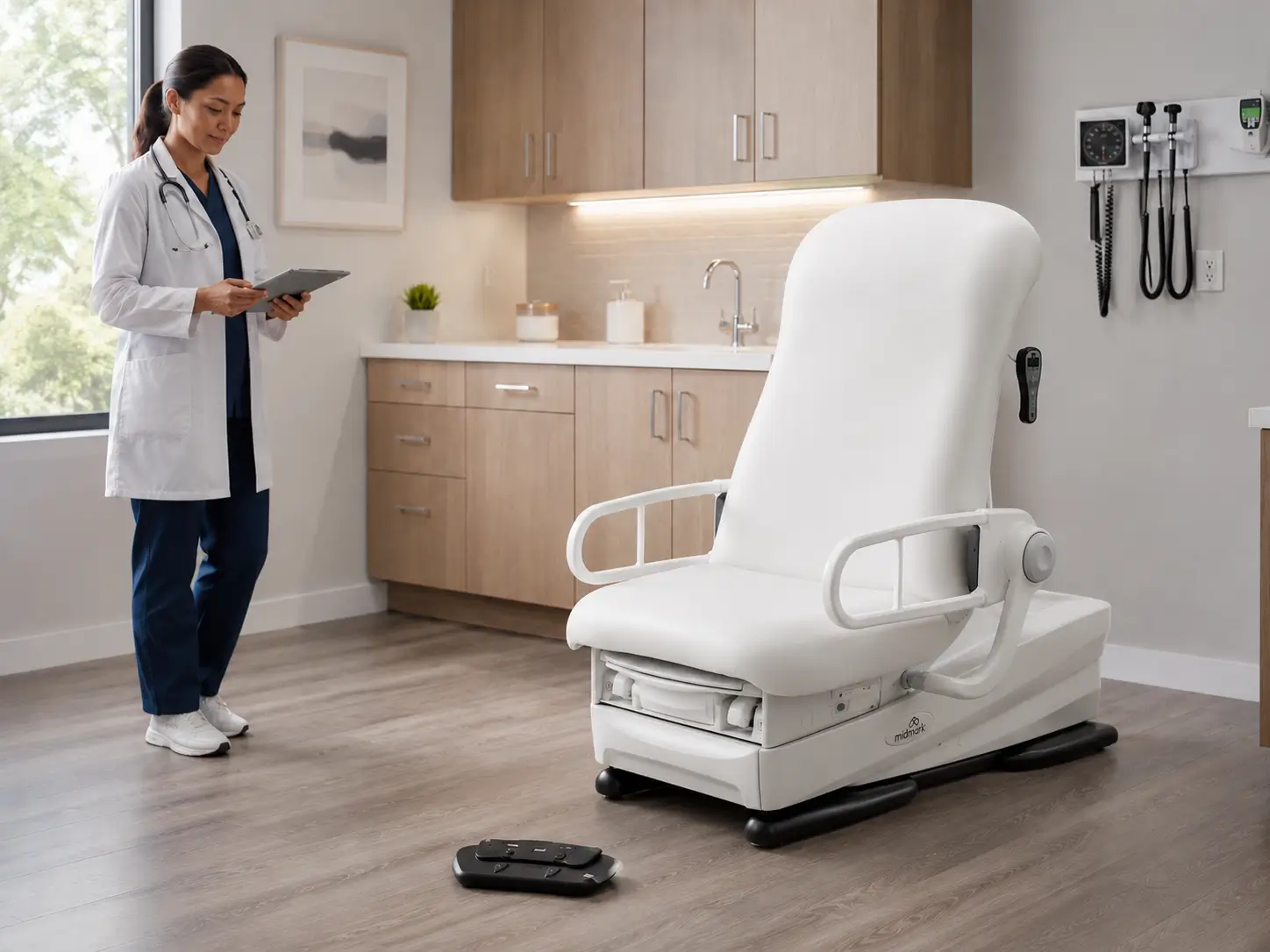
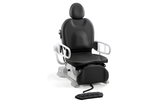
As a barrier-free reclining exam chair, the 626 answers the exam-table/chair requirement and beats the spec: it lowers to 15.5″ (14.6″ compressed), carries a 650 lb capacity, offers ADA-compliant support rails, and is portable-lift compatible.
But its optional integrated IQscale is a chair scale — it weighs a patient after they've transferred onto the chair. That's a genuine workflow win for patients who can transfer, but it is not an M303 wheelchair scale, and it can't weigh a patient who is unable to leave their wheelchair. So a 626 with IQscale covers Obligation 1, not Obligation 2.
Choosing a compliant wheelchair scale
Most compliant roll-on scales share the same core specs — 1,000 lb capacity, low-rise 1:8 ramps, EMR connectivity — so the real decision is format and certification:
- Best value, certified: the Health o meter 2620KL — Corada Platinum certified with an extra-large 32″×40″ deck.
- Legal-for-trade accuracy: the Detecto 7150-AC — NTEP certified with a 40″ platform and side guide rails.
- Space-saver: the Health o meter 2920KL-AM — a wall-mounted fold-up that folds to about 4.7″ from the wall.
- Rugged portable: the Rice Lake 350-ADA-1 — a metal-deck dual-ramp scale with an integrated handrail.
Frequently asked questions
What is the deadline for ADA exam table and wheelchair scale compliance?
HHS-funded providers (Section 504) must have at least one accessible exam table and one accessible weight scale by July 8, 2026. State and local government entities (ADA Title II) must meet the same minimum by August 9, 2026. Equipment acquired on or after October 8, 2024 must already be accessible until the facility reaches its scoping threshold.
Do I need both an accessible exam table and an accessible weight scale?
Yes. They are two separate obligations, counted and enforced independently. Covered facilities need at least one of each.
Is the required transfer height 17 inches or 17 to 19 inches?
The Access Board's 2024 final rule sets 17″, but the enforceable DOJ and HHS rules currently allow the 17–19″ range. A table that reaches 17″ or lower is the most future-proof choice.
Does an exam table with a built-in scale meet the wheelchair scale requirement?
No. A built-in scale weighs a patient after they transfer onto the table (a "chair scale"). It doesn't meet the M303 wheelchair-scale standard and can't weigh a patient who can't leave the wheelchair, so it doesn't satisfy the scale requirement on its own.
What makes a wheelchair scale ADA compliant?
A roll-on platform sized for a wheelchair, an accessible ramped entry (generally no steeper than 1:12, or 1:8 for low-rise runs with a maximum rise of 2.5 inches), raised edge protection, a slip-resistant surface, and adequate capacity — ideally with independent third-party certification.
Do all of my exam tables and scales have to be replaced?
No. New equipment must be accessible until at least 10% of each type meets the standards (minimum one unit), or 20% for mobility-focused practices.
Primary sources
- U.S. Access Board — Standards for Accessible Medical Diagnostic Equipment (36 CFR Part 1195)
- U.S. Department of Justice — ADA Title II MDE final rule (August 2024)
- U.S. Department of Health & Human Services — Section 504 MDE final rule
- Product specifications per Midmark, Health o meter (Pelstar), Detecto (Cardinal), and Rice Lake documentation
This article is educational and is not legal advice. Verify requirements against the primary sources for your facility type; undue-burden determinations should involve legal counsel.
Recent Posts
-

ADA Exam Table & Wheelchair Scale Requirements: 2026 Compliance Guide
Compliance Guide ~7 min read New federal rules require most healthcare facilities to have accessib …7th Jul 2026 -
Medical Device Industry: 7 Trends to Watch for Your Practice
TL;DR: The medical device industry is evolving rapidly, transforming how healthcare professionals de …29th Dec 2025 -

The Difference Between 224 and 225 Midmark Power Tables
When it comes time to purchase a new exam chair for your practice, you’ll have many options and bran …11th Dec 2025