ADA‑Compliant Power Tables

ADA-Compliant Exam & Procedure Tables (2026) – ExamTablesDirect

ADA-Compliant Exam & Procedure Tables & Scales (2026)

A quick guide to current Medical Diagnostic Equipment accessibility standards—plus recommended ADA power tables and scales.

ADA Compliance Quick Guide

  • Low height: Adjustable to 17–19″ low seat height
  • Transfer surface: At least 21″ wide by 17″ deep clear space
  • Side supports/rails: Solidly mounted for stability
  • Two-side access: Two adjoining sides of the seat must be accessible for transfers
  • Stirrups & leg supports: Provided and positioned for safe, accessible use when needed
  • Platform size: At least 36″ × 36″ for wheelchair scales
  • Ramp slope: No steeper than 1:8 (1″ rise per 8″ of length)
  • Platform height: ≤ 3″ from the floor for ramp accessibility
  • Side rails/guides: Provided to safely position the wheelchair on the platform
  • Handrails: Required on standing scales for ambulatory patient stability
Any practice accepting Medicare, Medicaid, or CHIP
Must meet compliance thresholds for tables and scales by
July 8, 2026
State & local government entities (Title II)
Must meet compliance thresholds for tables and scales by
August 9, 2026
General practices: At least 10% of exam tables and scales must be ADA-compliant
Mobility-focused practices: At least 20% of exam tables and scales must be ADA-compliant

In 2024 the U.S. Access Board (the independent federal agency that writes accessibility standards) updated the MDE standard for exam and procedure tables to require a low transfer height of exactly 17". The DOJ and HHS have not yet adopted that change and continue to enforce the 2017 standard with a 17–19" low height range. Similarly, the Access Board's 2024 update refines scale platform dimensions and ramp standards; DOJ/HHS currently enforce the 2017 baseline. The DOJ may issue a supplemental rule adopting the stricter 17" seat height and updated scale standards in the future.

Deadlines

July 8, 2026

Any practice accepting Medicare, Medicaid, or CHIP — at least 10% of tables & scales (20% for mobility-focused practices) must be ADA-compliant.

August 9, 2026

State & local government entities — at least 10% of tables & scales (20% for mobility-focused practices) must be ADA-compliant.

Exam & Procedure Tables

View all tables

You’ve got the table covered.
The scale is the other half.

The 2024 ADA / Access Board standards require two separate accessible units — a compliant exam table and a wheelchair-accessible scale.

An integrated table scale only weighs patients who can transfer, so it doesn't satisfy the scale rule on its own. Pair your table with a dedicated roll-on scale — all rated 1,000 lb, 1:8 ramps, EMR-ready.
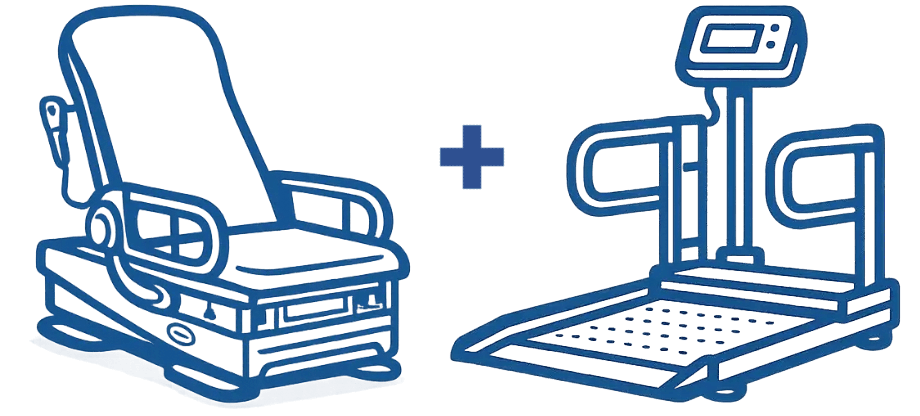
ADA-compliant exam table paired with a wheelchair-accessible scale

ADA Scales

View all scales

FAQ

Is a 17″ low height required today for tables?

For DOJ Title II and HHS recipients, enforcement is based on the 2017 MDE standard requiring an adjustable low transfer height within 17–19″. The Access Board's 2024 update sets a single 17″ low height, but DOJ/HHS haven't adopted it yet. Picking a 17″ model is the safest, future-ready choice.


Do I need an ADA-compliant scale as well as a table?

Yes. Both HHS recipients and Title II entities must have ADA-compliant tables and scales by their respective 2026 deadlines. General practices must ensure at least 10% of their exam tables and scales are ADA-compliant; mobility-focused practices must reach 20%. Scales must accommodate wheelchair users (or ambulatory patients with limited mobility) and meet the platform size, ramp slope, and handrail requirements in the MDE standard.


Do I need to replace every table or scale?

Not necessarily. The standard requires that at least 10% of exam tables and scales be ADA-compliant for general practices, and at least 20% for mobility-focused practices — not a full replacement of every unit. New purchases should meet the standard. Check which rule applies to your organization (HHS recipients vs. state/local entities) and assess your current inventory to determine how many compliant units you need.


Is two-side transfer access required for tables?

Yes. Two adjoining sides of the seat must be accessible for transfers, and transfer supports/rails are required to assist the patient.


What ramp slope is required for wheelchair scales?

The ADA MDE standard requires a maximum slope of 1:8 — that is, no more than 1 inch of rise for every 8 inches of ramp length. All wheelchair scales listed here include compliant 1:8 approach ramps. A shallower slope is always acceptable and easier for caregivers.


Does an integrated table scale (like the Midmark IQscale) count as my ADA-compliant scale?

Not by default. Scales built into an exam table, such as the Midmark IQscale, don't meet the MDE standard's platform size, ramp, and handrail requirements for wheelchair/ambulatory access, so they don't satisfy the scale portion of the ADA requirement on their own. You'll still need a separate ADA-compliant scale to hit your facility's compliance percentage.


Are support rails required for tables?

Yes. To meet the 2024 U.S. Access Board accessibility requirements for exam tables, the table must include compliant transfer supports, which are typically provided in the form of support rails.


What makes support rails ADA compliant?

Two things. First, placement: the rail has to serve as a transfer support within reach of the transfer surface — positioned so a patient transferring from a wheelchair can actually grab it during the transfer, not mounted where it's out of reach. Second, strength: structurally, it must resist vertical and horizontal forces of 250 lbs at all points and not rotate within its fittings. A rail that spins in its socket or flexes fails, regardless of where it's placed.


What makes a table "accessible" under the standard?

Key items include low transfer height within 17–19″ (choose 17″ models to align with the 2024 Access Board update), transfer surface ≥21″ wide × ≥17″ deep, sturdy transfer supports/rails, and side & end access to allow transfers from the long and short sides.


Are stirrups required?

No. Stirrups are optional. If used, you must also provide leg supports that meet the MDE spec for positioning and securing the legs. Transfer supports are a separate requirement.

Compliance can vary based on product configuration and facility requirements. Specifications are subject to change. For guidance specific to your needs, please talk to one of our specialists.

Talk to a Specialist

* This page is a summary for purchasing decisions and is not legal advice. Always confirm requirements with your compliance officer and the official standards. It is the purchaser's responsibility to ensure all equipment meets requirements for their respective cases.